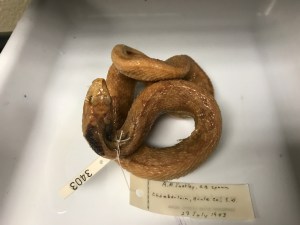
 I recently discovered a preserved Eastern Hog-nosed Snake (Heterodon platirhinos) from Brule County, South Dakota (pictured) that represents an important distributional record in the state. Heterodon platirhinos was historically known from southeastern South Dakota in Union and Clay counties. This specimen, from Chamberlain, is roughly 300 km up the Missouri River from previously known localities in Clay County, South Dakota. This historic specimen, combined with recent observations of H. platirhinos from western South Dakota (see https://www.herpmapper.org/record/193175) suggest this species may be present in additional localities across the state and further surveys for this state-threatened species should be a conservation priority.
Davis DR. 2018. Geographic distribution: USA, South Dakota, Brule Co.: Heterodon platirhinos (Eastern Hog-nosed Snake). Herpetological Review 49:76. [PDF]
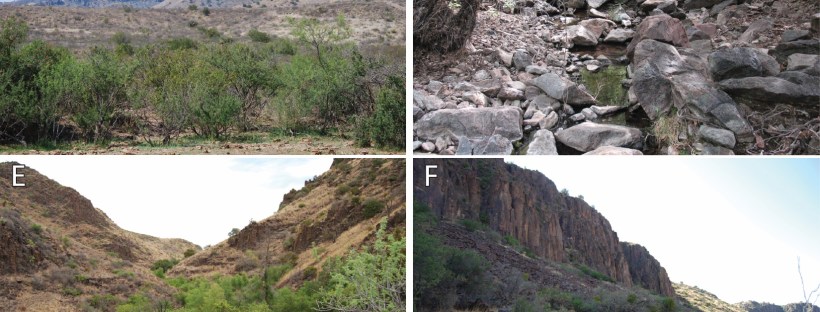
 We report the occurrence of 50 species of amphibians and reptiles recently collected on C. E. Miller Ranch and the Sierra Vieja in the Chihuahuan Desert of Texas, USA and describe their perceived distribution and abundance across various habitat associations of the region. Our recent surveys follow intense, historic sampling of amphibians and reptiles from this region in 1948. Of the 50 species detected in recent surveys, six were not collected in 1948 and an additional three species documented in 1948 have yet to be detected in a 14-year period of recent surveys. Combining data from both historic and recent surveys, a total of 53 species of amphibians and reptiles are known from the ranch (11 amphibians, 42 reptiles). Land stewardship and conservation practices have likely contributed to the persistence of the majority of these species through time. Additionally, we discuss the status of amphibians and reptiles not collected during recent surveys and comment on potential species that have not yet been detected.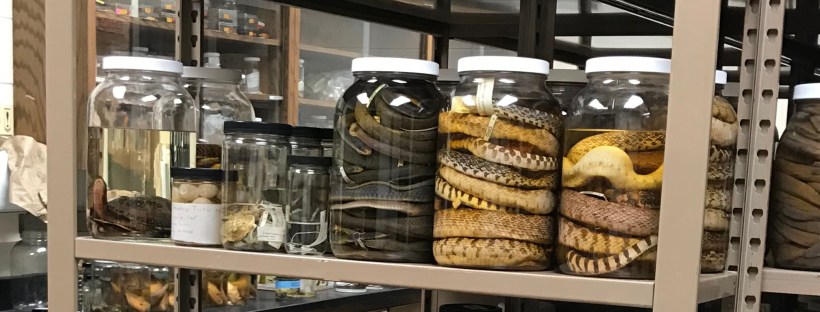
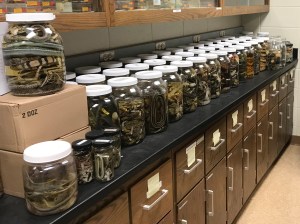 I recently deposited approximately 3600 amphibian and reptile specimens (DRD Field Series) and 3000 tissue samples at the Biodiversity Collections, University of Texas at Austin. These specimens are primarily collected from South Dakota and northeastern Nebraska, but also represent recent collecting trips to Michigan, Wisconsin, and Iowa. Further, this collection includes former South Dakota State University, W. H. Over Museum of Natural History, University of Sioux Falls, Augustana University, and Wayne State College specimens. Travis LaDuc, Curator of Herpetology at the Biodiversity Collections, recently traveled up to Vermillion to pick up these specimens from me at the University of South Dakota. Two days of driving later, they have all arrived safely in Austin, Texas. Specimens will be cataloged over the coming months and soon be available for researchers to loan out for studies.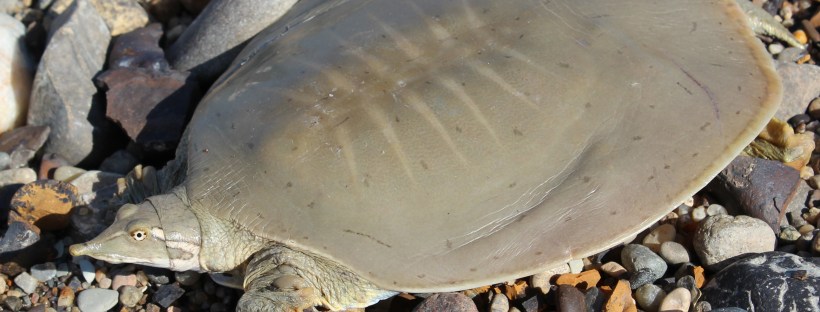
 South Dakota amphibian and reptile distributional records are lacking, especially in the north-central counties in the state. To date, there have been few surveys of amphibians and reptiles from along Lake Oahe, a large reservoir on the Missouri River that was created in 1958 following construction of Oahe Dam. We conducted fieldwork on Lake Oahe in South Dakota in June 2017 and collected 13 new county records of six species of amphibians and reptiles: Woodhouse’s Toad (Anaxyrus woodhousii), Boreal Chorus Frog (Pseudacris maculata), Smooth Softshell (Apalone mutica), Spiny Softshell (Apalone spinifera), Painted Turtle (Chrysemys picta), and Plains Gartersnake (Thamnophis radix).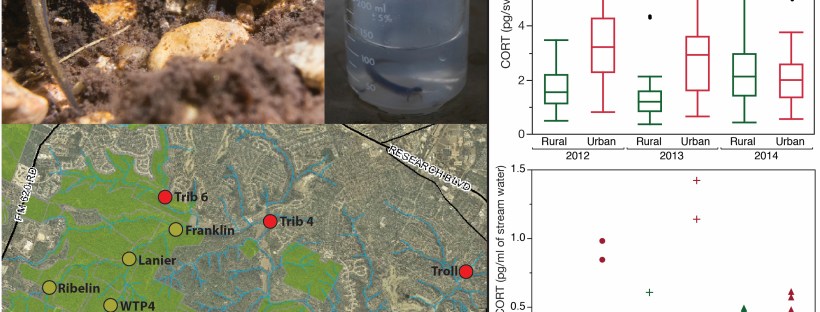
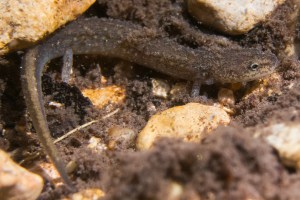


 I recently returned from the Joint Meeting of Ichthyologists and Herpetologists (JMIH) in Austin, TX where I presented both an oral and a poster presentation. My oral presentation, “Physiological Stress and Pathogen Infection in Larval Salamanders from Agricultural Wetlands”, was on one of my dissertation chapters and my poster presentation, “Morphological Variation between two widely distributed populations of Plethodon albagula (Caudata: Plethodontidae)”, was a continuation of work that I began as an undergraduate at the University of Texas at Austin.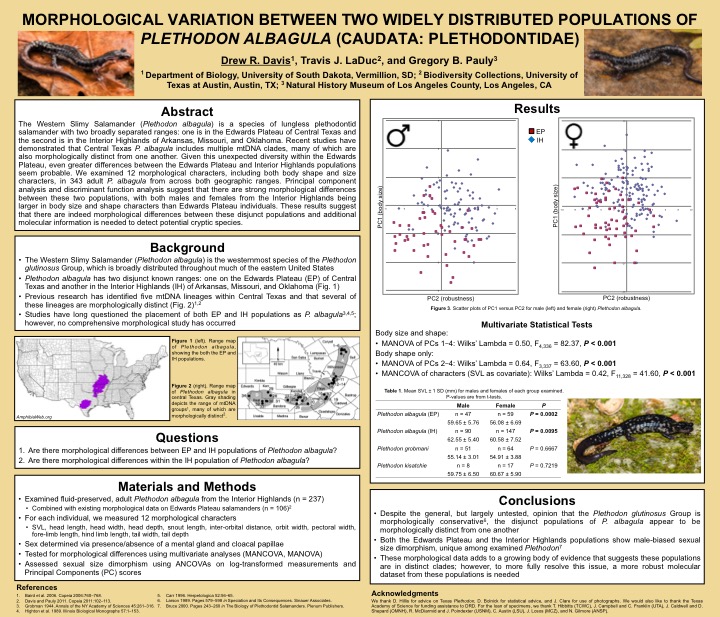
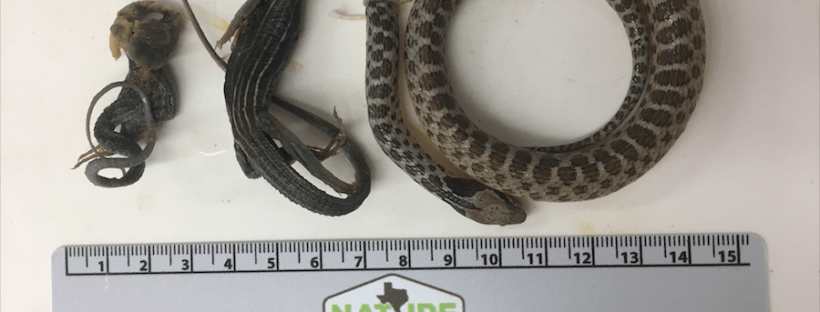
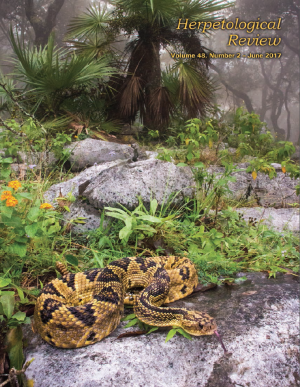
 Two natural history notes were published in the June 2017 issue of Herpetological Review. One note reports a new prey item and a new maximum prey/predator mass ratio for the Chihuahuan Nightsnake (Hypsiglena jani) and is co-authored with Travis J. LaDuc. Previously, the maximum prey/predator mass ratio known for Hypsiglena was 0.54 reported by Lacey et al. (1996), but our observation increases the maximum to 0.58. The two prey items that were consumed by this individual were two Little Striped Whiptails (Aspidoscelis inornata). Additionally, this observation adds to the list of prey species known to be consumed by Hypsiglena as only two other species of Aspidoscelis have been reported in the diet of Hypsiglena.
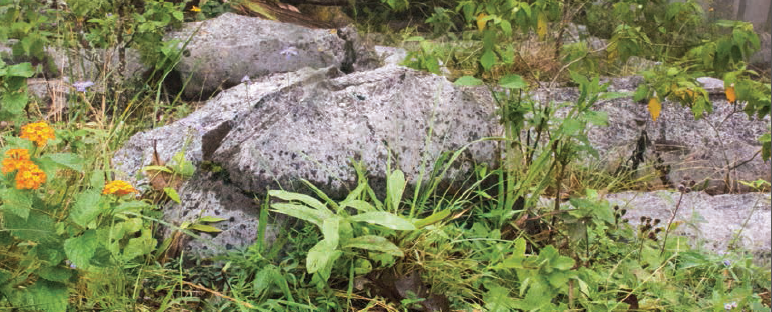
 A new publication documenting the historic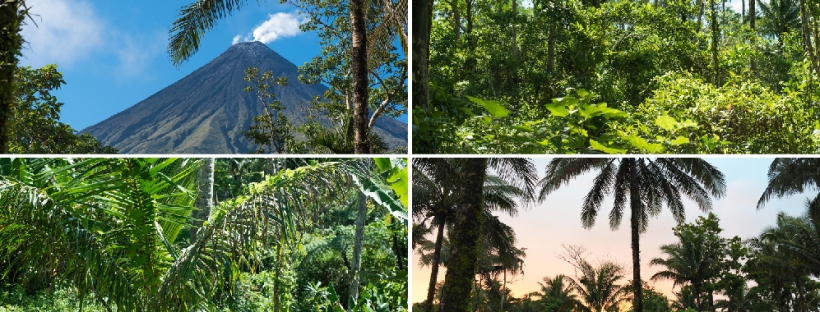
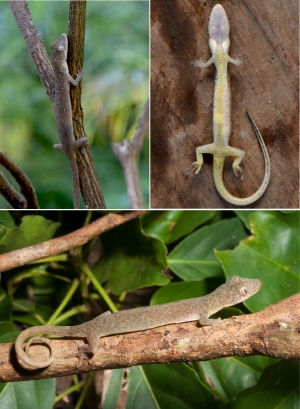 The Philippines possess a remarkable species diversity of amphibians and reptiles, much of which is endemic to this Southeast Asia island nation. Lizard diversity in the family Gekkonidae is no exception, with more than 80% of the country’s gecko species endemic to the archipelago, including the entire genus of False Geckos (Pseudogekko). This small radiation of diminutive, slender, arboreal forest species has been the focus of several recent phylogenetic and systematic studies that have highlighted the prevalence of undocumented species concentrated in several geographical regions within the archipelago. Newly available genetic data have led to the revision of two species complexes in the genus Pseudogekko, one of which is the focus of this study. We describe a new member of the Pseudogekko brevipes complex, which represents the first population from this species group discovered in the Luzon Faunal Region. Because of the species’ secretive nature, rarity, or restricted geographic range, it has gone undetected despite recent biodiversity surveys targeting the central and northern portions of the Bicol Peninsula. We evaluate both morphological and genetic data to support the recognition of the new species. All three members of the P. brevipes complex have allopatric distributions situated within three of the archipelago’s distinct faunal regions. The recognition of the new species increases the total number of taxa in the genus Pseudogekko to nine species.
 Drew R. Davis, Ph.D.