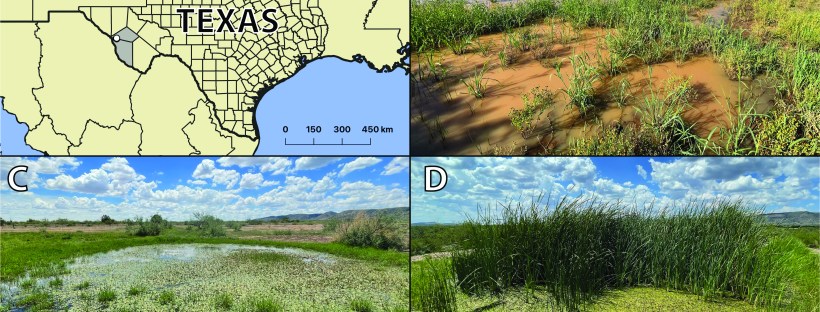
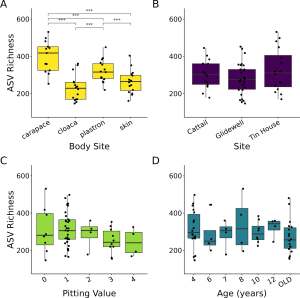
 Microbiomes are important to the ecology and evolution of their associated animal hosts. These important functions range broadly from individual animal health to population-level adaptations. Turtle-associated microbiomes are under increasing investigation, given turtles’ conservation status and the unique natural history of the shell as an evolutionary-developmental novelty. Many components of the turtle-microbiome interaction remain understudied, including how microbial communities assemble based on host and environmental factors. Here, we hypothesized that age, habitats, and body sites would exhibit significant differential effects on bacterial microbiomes in the Yellow Mud Turtle (Kinosternon flavescens) in the Chihuahuan Desert of west Texas, USA. We also hypothesized there would be differentialabundance of specificbacterial taxa associated with a recently described, algae-mediated shell disease. Using 16S rRNA amplicon sequencing of 64 turtle samples, we found bacterial community differencesamong body sites (cloaca, carapace, plastron, and skin), but weaker trends associated with habitat types (ephemeral or permanent-water ponds), and over age gradients (age 4–12+ years). Specifically,the carapace and plastron hosted high bacterial richness compared to the skin and cloaca, and all body sites differedin their bacterial composition across habitat sites. In many individuals, including those with advanced stages of the algae-mediated shell disease (Stage 3 or 4; 25% of sampled turtles), we detected significantdifferentialabundance of specificbacterial taxa, including Cyanobacteria strains. These results are important for informing sampling regimes in long-term studies related to K. flavescens ecology and evolution, and for continuing conservation and natural history work associated with turtles broadly.
Madison JD, Davis DR, Genter BW, LaDuc TJ, Muletz Wolz C. 2026. Microbiome varies by body site in the yellow mud turtle, Kinosternon flavescens, from the Chihuahuan Desert. Microbiology Spectrum 14:e03664-25. [PDF]

