
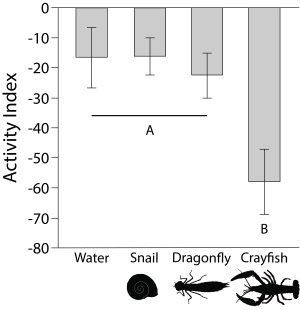
 The Barton Springs Salamander, Eurycea sosorum, is a fully aquatic salamander found in Barton Springs in Texas, USA, and has benefited from habitat restoration efforts. While important to improve overall habitat quality for this imperiled species, current management and restoration practices may also inadvertently increase the abundance of non-target organisms such as predatory invertebrates. Fish represent major predators of this species, but little is known about the role of invertebrates as potential predators. It is important to understand the role of these aquatic invertebrates as predators of E. sosorum, especially if habitat restoration also increases predator abundance. Using adult, predator-naive salamanders, we examined the antipredator response of E. sosorum to chemical cues from the following treatments: crayfish, dragonfly larvae, snails, and water. Salamanders decreased activity (antipredator behavior) only in response to the crayfish treatment. The responses to dragonfly larvae, snails, and water did not differ, suggesting that dragonfly larvae are not perceived as predators by these salamanders. Our study provides preliminary evidence suggesting that habitat restoration has unexpectedly increased crayfish abundance, which in turn may negatively affect E. sosorum, and that future management strategies should consider crayfish removal if salamander abundances decline with increasing crayfish abundance.
Davis DR, DeSantis DL, Gabor CR. 2017. Antipredator behavior of the Barton Springs Salamander (Eurycea sosorum) in response to aquatic invertebrates: potential consequences from habitat restoration. Hydrobiologia 795:129–137. [PDF]
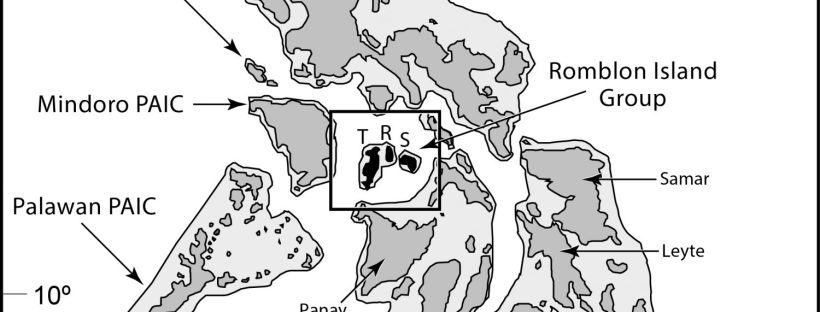
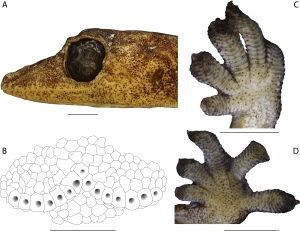 We describe a new species of lizard in the genus Pseudogekko from Sibuyan and Tablas islands in the Romblon Island Group of the central Philippines. The new species is diagnosed from other Philippine Pseudogekko by body size and shape, color pattern, and multiple differences in scale characteristics. Pseudogekko isapa sp. nov. has been collected only twice from leaves of shrubs in forested habitat on Sibuyan and Tablas islands. The distinctive new species of false gecko is undoubtedly endemic to this single, isolated island group. The fact that populations of such a distinctive new species of Pseudogekko has escaped notice of herpetologists on the reasonably well-studied and largely protected Sibuyan Island further emphasizes the secretive and forest-dependent habits of Philippine false geckos. These characteristics of their behavior and natural history render them difficult to study and challenge biologists’ efforts to accurately assess their conservation status.
